





Walton County has been named in 8 federal disaster declarations for storms, flooding or fire since 2000, and the most recent ones, Hurricane Isaias and a severe winter storm among them, are the kind of events that leave water sitting somewhere in a house long after the rain stops. That’s the part that turns a bad storm into a mold call three weeks later. We answer calls 24/7, and if your Monroe house took on water recently, what you do in the next day or two matters more than almost anything that happens after.

A storm like Isaias doesn’t have to flood your house to cause a mold problem. Wind-driven rain gets under flashing, a gutter overflows against the foundation, a tree limb opens a seam in the roof. None of that looks dramatic. It just means water is sitting in a wall cavity or under a subfloor where nobody’s looking.
After any of the weather Walton County has seen since 2000, the practical move is to walk the house the next morning. Check baseboards for swelling, press on drywall near windows and exterior walls, and smell for the mustiness that shows up before any visible growth does. If you find damp material, get air moving on it and get it dry. Waiting a week to decide it’s probably fine is how a small leak becomes a remediation job.
Insurance claims for water and mold damage usually come down to documentation: when the water event happened, what got wet, and how fast it was addressed. An adjuster is going to ask for photos, a timeline, and often a clear line between what the storm did and what was already a maintenance issue. We document the moisture source, the affected materials, and the drying process as we go, because that paperwork is what carries a claim forward. We don’t tell you what your policy will pay. That’s between you and your insurer. Our job is to make sure the record of the work is solid enough that the conversation isn’t a guessing game.
Mold needs two things: moisture and time. The EPA says water-damaged materials dried within 24 to 48 hours will, in most cases, not grow mold at all. Past that window, drywall paper, wood framing, and the backing on carpet all start feeding growth, and once it’s established in a wall cavity, wiping the surface doesn’t fix anything underneath.
Professional mold remediation work follows the IICRC S520 standard, which lays out how containment, removal of damaged material, and drying are supposed to be done so the job doesn’t just push spores into the next room. Containment keeps the affected area isolated while damaged material comes out, and drying afterward is what actually stops regrowth, not the removal alone.
Here’s what you can check yourself today: the EPA says a moldy patch smaller than about 10 square feet is usually something a homeowner can clean on their own. Bigger than that, or if it followed real water damage, that’s a job for someone who can verify the moisture source is actually gone, not just the mold you can see. Monroe’s older housing stock makes this more relevant than it might sound. About 55% of homes here were built before 1980, and older framing and plaster systems don’t always show water the way newer drywall does. A stain the size of a dinner plate on an old plaster wall can mean a lot more water moved through it than the stain suggests.

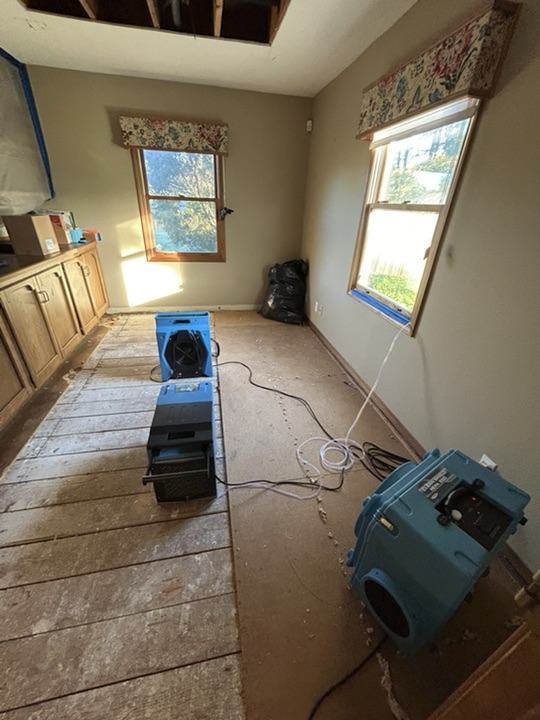
FEMA’s records show 18 National Flood Insurance Program claims filed for Monroe’s ZIP codes, 30655 and 30656, since 2000, with the most in any single year being 4, back in 2009. That’s not a lot of claims spread over more than two decades, and it covers both ZIP codes together, not any one street or house.
A flood map or a claim history tells you about an area’s pattern, not about your particular foundation or grading. A house can sit outside any mapped flood zone and still take on water from a bad roof, a cracked slab, or ground that slopes the wrong way toward the house. The claims number is useful context. It’s not a verdict on your property one way or the other.
About 40% of occupied homes in Monroe are owner-occupied, with the rest rented. That split changes who we’re actually talking to on a job. An owner can authorize removal and repair on the spot. A renter usually has to loop in a landlord or property manager before containment and removal can start, which can add a step to a process where speed already matters. If you’re renting in Monroe and you’ve found a moisture problem, getting that conversation started early is worth doing before the mold spreads past the point where a small cleanup would have handled it.
Committed Restoration handles mold inspection, containment, removal of damaged materials, and the cleaning and drying work that follows, and we’re IICRC certified and answer calls 24/7.
The EPA says a homeowner can usually handle a moldy area smaller than about 10 square feet on their own; larger areas, or mold that followed significant water damage, call for a professional who can confirm the moisture source is gone.
Because the moisture source wasn’t fully dried out, not because the cleanup missed a spot. The EPA notes that materials dried within 24 to 48 hours generally won’t grow mold, so anything still damp past that window keeps feeding regrowth even after the visible mold is wiped away.
It can. About 55% of Monroe’s housing was built before 1980, and half the homes in town date to 1976 or earlier by Census estimates, which means plaster, old subfloors, and framing that don’t always show water damage the way newer materials do.
About 40% of occupied homes in Monroe are owner-occupied, so renters are a sizable share of the market here; if you’re renting, getting your landlord looped in early matters since removal and repair work typically needs their authorization.
Sources: US Census Bureau, American Community Survey 2023 5-year estimates; FEMA, OpenFEMA NFIP Redacted Claims; FEMA, OpenFEMA Disaster Declarations Summaries; IICRC, ANSI/IICRC S520 Standard; US EPA, A Brief Guide to Mold, Moisture and Your Home. Read 2026-11-14.