





Gwinnett County has been named in 9 federal disaster declarations for storms, flooding or fire since 2000, most recently Hurricane Isaias, a severe winter storm, and Hurricane Helene. That is not a Buford number specifically, it covers the whole county, but it tells you something real: this area gets hit often enough that wet crawl spaces and slow leaks behind walls are a regular call for us, not a rare one. If you have standing water, a musty smell that will not go away, or a leak you only just found, that is where mold removal and remediation starts.

When a named storm or a flood declaration touches this county, the damage inside a house rarely shows up all at once. A roof leak from wind-driven rain, a sump pump that could not keep up, a crawl space that took on water, these sit quietly for a day or two before anyone notices the smell.
The hours right after matter. Pull up carpet edges if they are wet, run a dehumidifier or box fans if you have power, and open interior doors so air moves between rooms. Do not wait to see if it dries on its own. If the county has just been through one of these declared events, assume moisture got somewhere you cannot see and have it checked.
Half the homes in Buford were built in 1994 or earlier, and about 29% date to before 1980, per Census estimates. Houses from that era were not built to today’s vapor barrier or ventilation standards, and by now most have had at least one plumbing or roofing repair somewhere along the way.
Older copper and galvanized plumbing develops pinhole leaks that can run for weeks inside a wall before anyone sees a stain. Older crawl spaces often lack a proper vapor barrier, which means ground moisture works its way up into subfloor and framing year-round, not just after a storm. None of this means an older Buford house has a mold problem. It means the places mold likes to start, behind baseboards, under old flooring, in a crawl space with bare dirt, are more common the older the house is.
Mold does not need much time. The EPA’s guidance is that materials dried within 24 to 48 hours of getting wet usually will not grow mold at all. Past that window, drywall paper, wood framing and insulation are all food sources, and the clock does not reset just because the surface looks dry.
That is the whole reason remediation and basic mopping up are different jobs. Our work follows the IICRC S520, the industry standard for mold remediation, which means containment of the affected area before anything gets disturbed, so spores do not spread into the rest of the house, removal of material that is actually damaged rather than guessing, and drying that is verified with equipment, not by feel. The EPA also notes a homeowner can usually handle a moldy patch smaller than about 10 square feet on their own. Anything bigger, or mold that followed real water damage, is past the point of a spray bottle and a sponge.
One thing you can check yourself today: look at anything that got wet more than two days ago. If you can still smell must, or the material feels damp to the touch, that is past the EPA’s dry window and worth a second look.

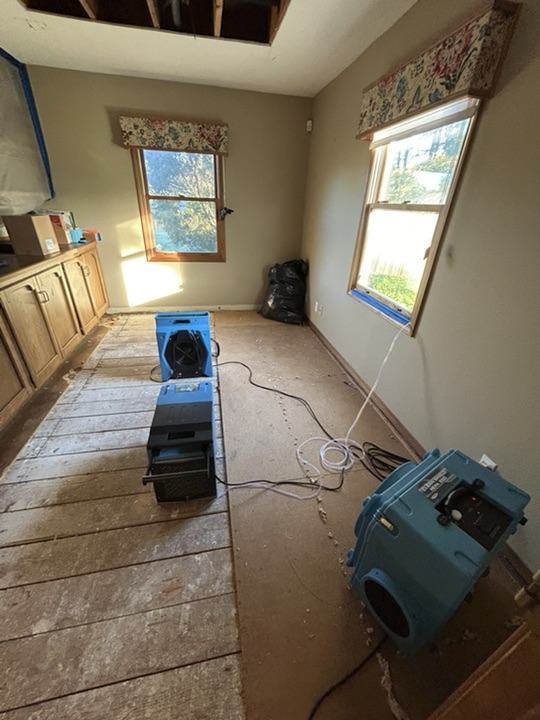
Buford’s stormwater program names Richland Creek and Suwanee Creek among the city’s receiving waters, meaning that is where runoff from streets and yards eventually drains. FEMA’s claims data shows 19 National Flood Insurance Program claims filed across Buford’s ZIP codes, 30518 and 30519, since 2000, with the busiest year being 2013 at 6 claims.
That history describes the area, not your particular lot. A property near one of those creeks is not automatically at higher flood risk, and a property farther away is not automatically safe, since most of the moisture problems we see start indoors, from plumbing, roofing or HVAC condensation, with no creek involved at all. A flood map or a claims count is a starting point for a conversation, not a verdict on one house.
Mold claims live or die on documentation, not on how bad the smell is. We photograph the affected materials before we touch anything, note moisture readings room by room, and keep a record of what gets removed and why. That paper trail is what an adjuster is going to ask for.
One distinction adjusters care about is whether the mold resulted from a sudden, covered event, like a burst pipe, or from longstanding moisture, like a slow roof leak nobody fixed. We cannot tell you what your policy will pay or how that gets decided. What we can do is give you a clear, dated record of conditions and cause so you are not guessing when the adjuster calls.
Committed Restoration handles mold inspection, containment, removal of damaged materials, and the cleaning and drying work that stops regrowth, and we’re IICRC certified with calls answered 24/7.
The EPA says a homeowner can usually clean a moldy area smaller than about 10 square feet on their own; anything larger, or mold following significant water damage, calls for a professional.
Mold returns when materials were not dried fast enough or thoroughly enough the first time, since the EPA’s research shows areas dried within 24 to 48 hours usually will not grow mold, while anything left damp longer than that keeps feeding regrowth.
Not necessarily. Buford’s stormwater program lists Richland Creek and Suwanee Creek as city receiving waters, and FEMA records show 19 flood claims across Buford’s ZIP codes since 2000, but that history describes the area, not any one specific property.
It can. Half of Buford’s homes were built in 1994 or earlier and about 29% predate 1980, and older plumbing and crawl spaces without modern vapor barriers are more prone to the slow leaks and ground moisture that lead to mold.
Sources: City of Buford, Stormwater Management Program (2023); US Census Bureau, American Community Survey 2023 5-year estimates; FEMA, OpenFEMA NFIP Redacted Claims; FEMA, OpenFEMA Disaster Declarations Summaries; IICRC, ANSI/IICRC S520 Standard; US EPA, A Brief Guide to Mold, Moisture and Your Home. Read 2026-11-14.