
Water Damage Restoration in Snellville, GA





Snellville’s public works department publishes drainage guidance that covers ditches, detention ponds and stormwater easements on private property, which tells you something useful before you ever call us: the city will tell you where the water is supposed to go, but it is on the homeowner to notice when it does not. By the time a basement is taking on water or a ceiling is staining brown, the ditch or easement did its job or it didn’t, and now the problem is inside your house, not the city’s right of way.
What actually brings Snellville homeowners to the phone
Half the homes in Snellville were built in 1989 or earlier, and about 30% date to before 1980. That is a lot of original plumbing, original roofing and original grading still doing its job decades past when it should have been checked. Supply lines corrode from the inside, roof flashing gives out, and galvanized pipe under an older slab starts to pinhole, none of it announced until a wall or ceiling tells you.
FEMA’s claims data shows 30 National Flood Insurance Program claims filed for Snellville’s ZIP codes since 2000, with the single worst year, 2009, bringing 8 claims. That is not a prediction for any one house. It is a record of what has happened across a wide area over two decades, and it is low enough that most of what we see here is not river or creek flooding at all. It is plumbing failures, roof leaks, and water that never made it to a ditch or detention pond the way the city’s drainage system expects.
Gwinnett County has been named in 9 federal disaster declarations for storms, flooding or fire since 2000, including Hurricane Helene in 2024 and a severe winter storm and Hurricane Isaias in 2026. Wind drives a shingle loose or a tree into a roofline, and the water that follows doesn’t wait for the storm to end before it starts soaking drywall and subfloor.
Getting a crew to a Snellville address
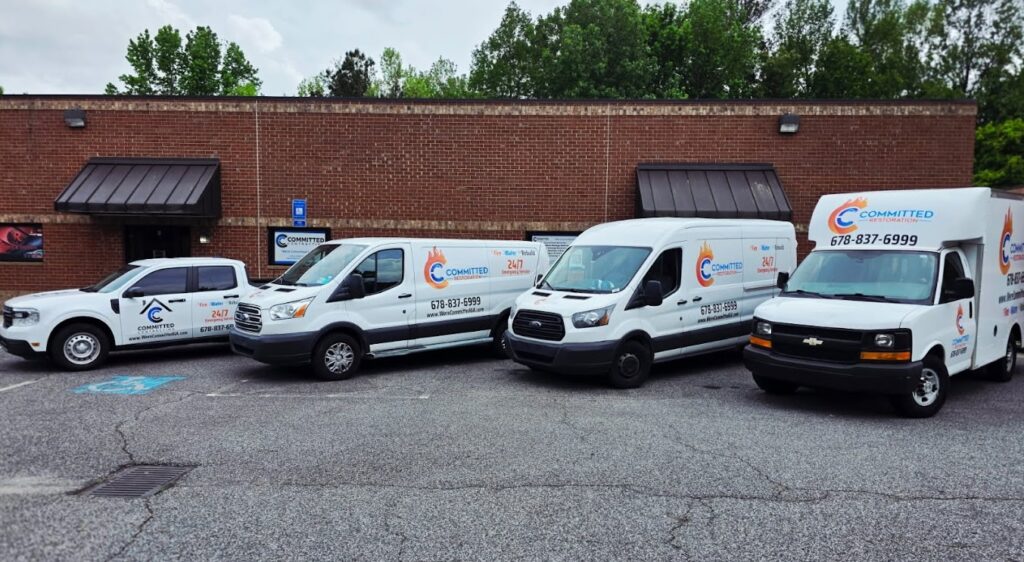
Committed Restoration answers calls 24/7, and in an emergency a crew typically arrives at a Snellville address within the hour. We’re based out of Lawrenceville, close enough that a call placed at 2 a.m. gets the same response as one placed at 2 p.m.
What we can’t tell you over the phone is how bad it is. A flood zone map or a claims count describes a ZIP code, not your crawlspace. The only way to know what water did to your specific house is to get eyes and a moisture meter on it.
What we handle for Snellville homes and businesses
Water damage restoration
When a supply line fails behind one of Snellville’s older walls or a roof gives out in a storm, we extract standing water, map the moisture that’s already migrated into framing and subfloor, and set up monitored drying before it spreads further. If the water carried sewage or came from a contaminated source, that gets cleaned and treated separately from clean-water loss. We repair the walls, floors and finishes the water reached and document everything along the way, because your adjuster will want a record of what happened and what it took to fix.
Water damage restoration in Snellville
Water mitigation
Mitigation is the work that happens before repair even starts: pulling standing water, removing wet insulation, carpet pad or drywall that won’t dry out in place, and setting equipment to pull moisture from what’s left. We take moisture readings through the whole process, not just at the start, because a reading that looks dry on day one can still be wet behind a baseboard on day three. We answer these calls 24/7, which matters since every hour wet materials sit is an hour closer to the window where mold becomes a real risk.
Water mitigation in Snellville
Fire damage restoration
After a fire, the first job is securing the property, boarding windows, tarping the roof where it’s been breached, so the house isn’t exposed to weather or entry while work gets planned. We remove what fire damaged beyond saving, clean up the water used to put the fire out (which often does more damage to floors and drywall than the fire itself), and rebuild the affected rooms. We document the loss for your adjuster as we go, following the IICRC S700 standard that governs fire and smoke restoration work.
Fire damage restoration in Snellville
Smoke damage cleanup
Soot and smoke travel further than the fire itself, settling into walls, ceilings, contents, and anywhere the HVAC system pulled air during the fire. We clean soot off surfaces, address the HVAC-affected areas so smoke doesn’t keep recirculating, and work through odor removal, which is a separate process from surface cleaning. Materials that absorbed smoke rather than just surface soot often need to be cleaned more aggressively or replaced outright, and we make that call room by room rather than guessing at the whole house.
Smoke damage cleanup in Snellville
Mold removal and remediation
Mold needs moisture to grow, so the first step is always finding where that moisture is coming from, not just where the mold is visible. We contain the affected area so spores don’t spread to the rest of the house during removal, take out what’s damaged beyond cleaning, and dry the space thoroughly afterward to keep it from coming back. This follows the IICRC S520 standard. Given how much of Snellville’s housing predates 1980, we see this follow old roof leaks and slow plumbing leaks that went unnoticed for a long time.
Mold removal and remediation in Snellville
Contents pack-out and storage
When a room or a whole house needs to be cleared out for drying or rebuild, we pack and remove belongings, clean what’s salvageable, and store it securely until the work is done. Everything gets inventoried going out, so there’s a record of what left the house and in what condition. When repairs are finished, we handle the move-back, which matters most for owner-occupied homes where someone is waiting to get their kitchen or bedroom back in order.
Contents pack-out and storage in Snellville
Storm damage cleanup and repair
Gwinnett County has seen 9 federal disaster declarations for storms, flooding or fire since 2000, including recent hurricanes, so storm cleanup is a regular part of our work here. That starts with board-up and roof tarping to stop further water intrusion, then extraction of any water that got in, cleanup after fallen trees and debris, and structural repair to whatever the storm damaged. We treat the tarping and the rebuild as one job rather than handing it off partway through.
Storm damage cleanup and repair in Snellville
Reconstruction after damage
Once the water, fire or storm damage is cleaned up and dried out, someone has to put the house back together, and we keep that with the same team that handled the cleanup. That means structural repairs, drywall, flooring and interior finishes, with one crew that already knows what’s behind the walls instead of a new contractor starting from scratch. For a house with original 1980s or older construction, that continuity matters when unexpected wiring or framing issues turn up mid-rebuild.
What happens next

Step 1
Inspect the damage and identify immediate protection or cleanup needs.
Step 2
Explain the estimate, affected belongings, and the sequence of work.
Step 3
Complete the necessary removal, cleaning, and monitored drying.
Step 4
Carry out agreed repairs and review the restored space with you.
What an older Snellville house means once a wall opens
With about 30% of the housing stock here built before 1980 and the median home dating to 1989, plaster, old drywall, and outdated wiring behind the wall are common enough that we plan for them, not around them. Opening a wall in a house this age sometimes means finding knob-and-tube remnants or undersized electrical that has nothing to do with the water damage but has to be addressed before the wall closes back up.
About 81% of occupied homes in Snellville are owner-occupied. That matters for the work itself: an owner making the call on repairs is usually also the one living in the house during the drying and rebuild, which changes how we schedule containment and sequencing compared to a rental where the tenant and the decision-maker are different people. Permits for structural and electrical work go through Gwinnett County or the City of Snellville depending on the scope and address, and we pull what the job requires rather than guessing which jurisdiction applies before we’ve seen the damage.
Questions from Snellville
Is there a 24 hour restoration company near Snellville?
Yes. Committed Restoration answers calls 24/7, and for a Snellville address a crew typically arrives within the hour of an emergency call.
Who handles water, fire, smoke and mold damage in Snellville?
We do, as one team: water damage restoration and mitigation, fire and smoke damage restoration, mold removal and remediation, contents pack-out, storm cleanup, and the reconstruction that follows any of it.
Will you talk to my insurance adjuster?
We document the damage as we find it so you have records for your adjuster, and we’re IICRC certified, which is the training standard an adjuster will recognize when reviewing the work.
How old are most homes in Snellville, and does that matter for a repair?
Half the homes in Snellville were built in 1989 or earlier and about 30% predate 1980, which usually means original plumbing or roofing that is past its expected life and more likely to be the actual source of a leak.
Does a low flood claims count mean my house won't flood?
No. FEMA’s records show 30 NFIP claims filed for Snellville’s ZIP codes since 2000, but that number describes the area over two decades, not any single property, and most water damage we see here comes from plumbing or roof failures rather than flooding.
Get restoration help in Snellville
Serving Homes & Businesses Across Snellville, GA
Serving Snellville, Lawrenceville & the Greater Atlanta Metro
More help in Snellville
- Water damage restoration in Snellville
- Water mitigation in Snellville
- Fire damage restoration in Snellville
- Smoke damage cleanup in Snellville
- Mold removal and remediation in Snellville
- Contents pack-out and storage in Snellville
- Storm damage cleanup and repair in Snellville
- Reconstruction after damage in Snellville
Nearby
Sources: City of Snellville, Stormwater and Drainage; US Census Bureau, American Community Survey 2023 5-year estimates; FEMA, OpenFEMA NFIP Redacted Claims; FEMA, OpenFEMA Disaster Declarations Summaries. Read 2026-11-14.