





FEMA’s records show 18 National Flood Insurance Program claims filed for Monroe’s ZIP codes, 30655 and 30656, since 2000, with the most in a single year, 4, landing in 2009. That is not a county’s worth of claims. It is just enough to tell you that water finds its way into houses here regularly, in ones and twos, year after year, and that the house it finds next probably is not thinking about flood maps when the pipe lets go or the storm drain backs up.

Eighteen claims since 2000 across two ZIP codes is a thin record, and thin records are easy to misread. It does not mean Monroe is safe, and it does not mean any one house is at risk. A flood claim count describes an area over two decades. It says nothing about the house on your particular street, how your lot drains, or whether your crawlspace has ever taken water.
Most of what we see in Monroe is not river flooding anyway. It is a washing machine hose that let go overnight, a water heater that finally rusted through, a toilet supply line nobody checked in years. None of that shows up in a flood claim. It shows up on a kitchen floor at 2 a.m., which is a different problem with a different fix, and it is the one we handle most.
Drywall, subfloor, baseboard and the framing behind them do not fail all at once. They wick. Water climbs paper-faced drywall by capillary action, soaks into particleboard underlayment, and sits in stud cavities where nobody can see it. The EPA’s guidance is that material dried within 24 to 48 hours will, in most cases, not grow mold. Past that window, the odds shift, and they keep shifting the longer the material stays wet.
The work we do follows the IICRC S500, which is the industry standard for water damage restoration. In practice that means documented moisture readings, not guesswork, and drying equipment left running and monitored until the material actually reads dry, not until it looks dry. For a Monroe homeowner the plain version is this: fast extraction and real monitoring change whether your subfloor gets saved or gets replaced.
One thing you can check yourself today, no tools needed: look under every sink and behind the washing machine and water heater for a slow drip or a damp spot on the cabinet floor. Most of the worst jobs we see started as something small enough to catch early.
About 40% of occupied homes in Monroe are owner-occupied, which means most households here are renting. That changes the first call. A renter usually needs to loop in a property manager or landlord before work starts, and documentation of the damage matters even more when two parties, not one, need to agree on what happened and when. We document the damage for the homeowner’s or landlord’s records and for the adjuster either way, but a renter should expect an extra conversation before extraction begins that an owner would not.

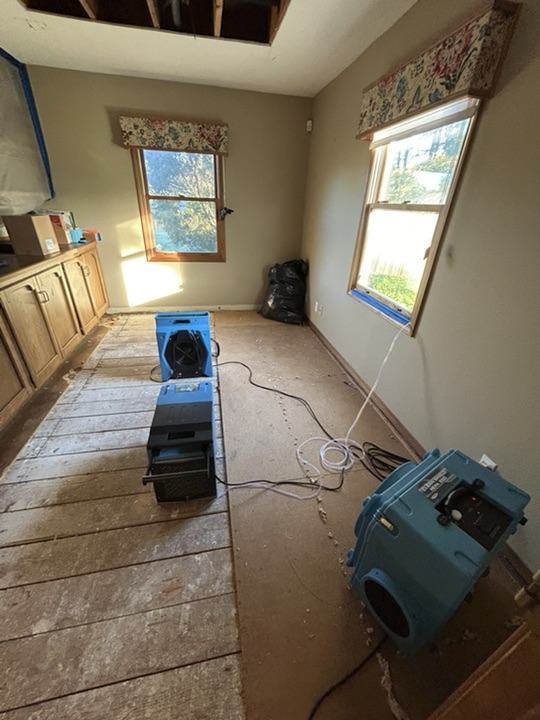
Half of Monroe’s homes were built in 1976 or earlier, and about 55% of the housing stock predates 1980. That matters for water damage in a specific way: older plumbing, older subfloor materials, and wall cavities that were never built with modern vapor barriers. Galvanized supply lines and old solder joints fail differently than modern PEX, often slower, often hidden behind a wall or under a slab, which means by the time you see a stain the water has usually been moving for a while.
Older homes also tend to have real plaster or older drywall assemblies, and sometimes original subfloor under newer flooring layers, which traps moisture where it is hardest to dry. None of that is a reason to panic. It is a reason to get moisture readings taken early, which is part of how we approach a job on a house of this age.
The work breaks down into a few parts, and most jobs touch all of them:
Most homeowners insurance does not cover flood damage on its own; flood coverage is a separate policy, and that distinction is usually the first thing an adjuster asks about on a claim. We do not tell you what your policy covers. We document what happened and let that conversation happen with your insurer, with records that hold up.
Committed Restoration answers calls 24/7, and we’re IICRC certified, which covers extraction, sewage cleanup, moisture mapping and the repair work that follows.
The EPA says material dried within 24 to 48 hours will, in most cases, not grow mold, which is why monitored drying starts as soon as extraction is done, not after.
Not necessarily. FEMA’s claims data covers Monroe’s ZIP codes as a whole, 18 claims since 2000, and that number describes the area, not any single property, so proximity to water is one factor among several, not a verdict on your house.
Most homeowners insurance does not cover flood damage specifically; flood coverage is a separate policy, which is why adjusters distinguish between a flood loss and other water losses before anything else.
Half of Monroe’s homes were built in 1976 or earlier, and older plumbing and subfloor materials tend to hide water longer, so moisture mapping matters more on an older house than on a new build.
Sources: US Census Bureau, American Community Survey 2023 5-year estimates; FEMA, OpenFEMA NFIP Redacted Claims; IICRC, ANSI/IICRC S500 Standard; US EPA, A Brief Guide to Mold, Moisture and Your Home; FEMA, FloodSmart (National Flood Insurance Program). Read 2026-11-14.