





FEMA’s records show 3 National Flood Insurance Program claims filed for ZIP code 30517 since 2000. That is a small number, and it covers a lot of ground, so do not read it as a prediction about any one house, including yours. What it does tell you is that most water damage in Braselton isn’t coming from a creek overflowing its banks. It’s coming from inside the house, a supply line, a water heater, a washing machine hose, and those don’t check a flood map before they fail.

Three claims since 2000 is a low count for a zip code this size. It means a flood insurance payout tied to a mapped flood event has been rare here. It does not mean your basement can’t take on water, and it does not mean the house next door shares your risk, because flood maps and claims data describe an area, not a single lot, a single grading job, or a single gutter that’s been clogged since spring.
If you want one thing you can check today, go look at where your downspouts actually discharge. A surprising amount of basement and crawlspace water in Braselton starts there, not at the creek.
Drywall wicks water upward fast, and the paper facing is a food source for mold the moment conditions are right. The EPA’s guidance is specific on this: material dried within 24 to 48 hours will, in most cases, not grow mold. Past that window, the odds move against you, and they keep moving.
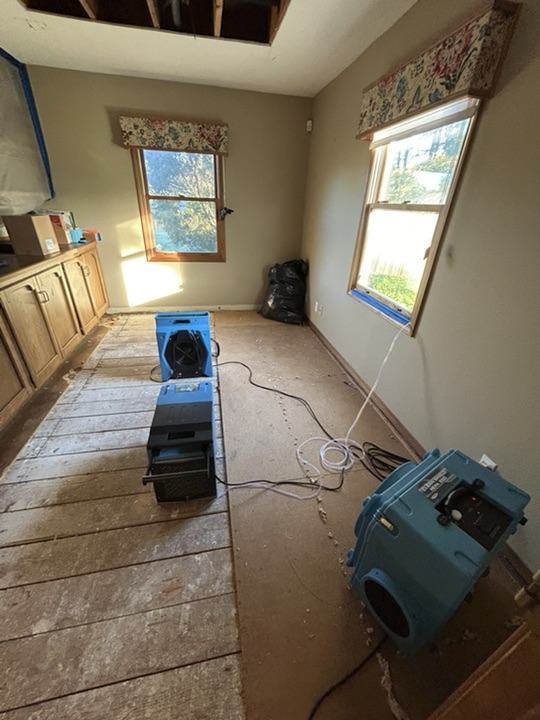
We work to the IICRC S500, which is the standard the restoration industry uses for drying and documenting a water loss in a home. In practice that means moisture mapping before we start, drying equipment placed and monitored against actual readings rather than guesswork, and a record of when materials were wet, dried, or removed. That record matters later, when you’re talking to an adjuster about what happened and when.
One more thing worth knowing before anyone calls you about a loss: most homeowners insurance does not cover flood damage. Flood coverage is a separate policy. A pipe that bursts inside your house is usually a different conversation with your insurer than water that comes in from outside, and that distinction is one of the first things an adjuster will sort out.
Half of the homes in Braselton were built in 2009 or earlier, and only about 3% of the housing here predates 1980. That makes this a young town, housing-wise, compared to a lot of the metro. Newer construction generally means PEX or newer copper supply lines instead of the galvanized pipe that fails from the inside out, and engineered flooring or newer subfloor instead of old plank.
That’s not nothing, but it’s not a guarantee either. Newer homes still have ice makers, washing machine supply lines, water heater connections and HVAC condensate lines, and those fail regardless of the year on the permit. What tends to differ in a newer Braselton home is less about whether a failure happens and more about what’s behind the wall once it does, oriented strand board instead of true lumber, for instance, which behaves differently once it’s wet.

Jackson County has been named in 10 federal disaster declarations for storms, flooding or fire since 2000, including Hurricane Isaias, a severe winter storm, and Hurricane Helene among the more recent ones. That’s a real pattern of weather serious enough to bring in federal declarations, not just a bad afternoon of rain.
After a storm like that passes, the hours right after matter. Check crawlspaces and basements for standing water even if nothing looks wrong at the surface. Check around window wells and any spot where a downspout empties close to the foundation. If you find water, get air moving and get it documented before you start cleaning it up yourself, because the order you do things in affects both the drying and the paperwork.
Every water damage job we work gets documented, the extent of the damage, moisture readings, what got removed and why, and photos as we go. That record is for your file as much as for the insurance company’s, and it’s the kind of detail an adjuster asks for anyway. We don’t tell you what your policy will or won’t pay. That’s between you and your insurer. What we can do is make sure the facts of the loss are written down clearly enough that the conversation is about coverage, not about what actually happened in your house.
Committed Restoration answers calls 24/7, and our work follows the IICRC S500 standard for water damage restoration, so the same process applies whether the call comes in at noon or at midnight.
The EPA says materials dried within 24 to 48 hours will, in most cases, not grow mold, which is why moisture mapping and monitored drying start as soon as we’re on site rather than being left for a follow-up visit.
Not necessarily. FEMA’s records show only 3 NFIP claims filed for ZIP code 30517 since 2000, but that count describes the whole zip code, not your specific lot, grading, or drainage, so it can’t tell you what your individual risk is.
Most homeowners insurance does not cover flood damage, since flood coverage is a separate policy, which is a distinction worth understanding before water gets in, not after.
About 76% of occupied homes in Braselton are owner-occupied, and who makes the call on cleanup and repairs, and who handles the insurance conversation, often comes down to that owner-or-renter line.
Sources: US Census Bureau, American Community Survey 2023 5-year estimates; FEMA, OpenFEMA NFIP Redacted Claims; FEMA, OpenFEMA Disaster Declarations Summaries; IICRC, ANSI/IICRC S500 Standard; US EPA, A Brief Guide to Mold, Moisture and Your Home; FEMA, FloodSmart (National Flood Insurance Program). Read 2026-11-14.