





Half of the homes in Braselton were built in 2009 or earlier, according to the Census Bureau, which means this is a young town by Georgia standards, full of houses still inside their first run of plumbing, water heaters, and PEX fittings. That’s good news in a lot of ways. It also means when something does fail, it’s usually a fitting or a supply line that was never expected to fail yet, and people are caught off guard by it. If you’re standing in water right now, Committed Restoration answers calls 24/7, and we’d rather talk you through the first ten minutes over the phone than have you guess.

Most Braselton homes are recent enough that you’re not fighting galvanized pipe or knob-and-tube wiring. Only about 3% of the housing stock here predates 1980, so the older-house problems we see in some nearby towns, brittle cast iron, lath-and-plaster walls that hold water like a sponge, just aren’t the typical story in Braselton.
What you do get is a lot of production-built construction from the same era: engineered subfloor, PEX or CPVC supply lines, water heaters and ice maker lines installed to code but not necessarily built to last fifty years. A supply line behind a washing machine, a failed water heater fitting, an ice maker line that was never fully seated, these are the common culprits in a house this age. When one of them lets go, water tends to move fast across smooth subfloor and under baseboards before anyone notices, especially overnight or while a family’s at work.
Drywall, baseboard, and subfloor don’t fail because water touched them once. They fail because water sat in them. Drywall wicks moisture upward from the bottom edge, and once it’s saturated past a certain point, it loses structural integrity and starts feeding mold. That’s why we cut low instead of trying to dry the whole wall: if the wet line is six inches up, we remove the wet six inches and leave the rest alone.
Our work follows the IICRC S500, which is the industry standard for water damage restoration. In practice that means documented moisture readings, not a guess based on how a wall feels to the touch, and a drying process that continues until the readings confirm the structure is actually back to normal, not just surface-dry. The EPA notes that materials dried within 24 to 48 hours generally won’t grow mold, which is the real reason speed matters on a call like this: it’s not about saving the carpet, it’s about beating that window.
One thing you can check yourself right now, today: look under sinks, behind the washing machine, and around the water heater for any dampness or discoloration. In a Braselton house, those fittings are usually only a decade or so old, but age isn’t the same as immunity, and a slow leak can run for weeks before it shows.
About 76% of occupied homes in Braselton are owner-occupied, so most of the time we’re dealing directly with the person whose name is on the mortgage and the insurance policy. That simplifies things. Decisions about what gets removed and when get made faster when the homeowner is standing in the kitchen with us.
The other quarter are rentals, and those calls work differently. We’re often coordinating between a tenant who found the water first, a property manager who has to approve the work, and sometimes an out-of-town owner who’s only reachable by phone. None of that changes how the drying gets done, but it does change how fast we can get everyone on the same page about it, so if you’re renting, having your property manager’s number ready when you call us saves a step.

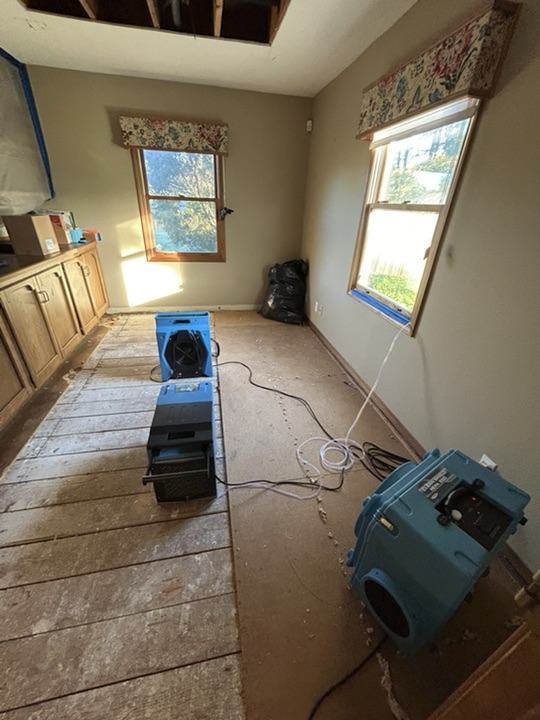
We document everything as we go: moisture readings at the start, readings through the drying process, photos of what was removed and why, and a record of the equipment running in your house. That’s the kind of documentation an adjuster expects to see, and it’s built into how we work under the IICRC S500 anyway, not something we assemble after the fact.
One distinction that comes up on nearly every claim is the difference between mitigation and repair. Mitigation is the emergency work: extraction, removing unsalvageable material, drying the structure. Repair is what comes after, rebuilding the drywall, replacing flooring. Adjusters typically want to see the mitigation handled and documented before repair estimates come in, and keeping those two phases distinct on paper tends to move a claim along faster. We’re not going to tell you what your policy will or won’t cover, that’s between you and your adjuster, but we’ll give you the record to have that conversation with.
Committed Restoration answers calls 24/7, so a 2 a.m. pipe burst gets a real person on the phone, not a voicemail. We can walk you through shutting off the water and protecting what’s salvageable before anyone arrives.
Water mitigation is the emergency work that stops the damage from getting worse: extraction, removing wet material that can’t be saved, and drying the structure. Restoration is the rebuild that comes after, like new drywall and flooring.
Because drywall wicks water upward from the bottom edge, and only the saturated section needs to come out. Cutting low lets us remove the damaged material and set drying equipment for what’s left, following the IICRC S500 process for documenting it’s actually dry.
The EPA says materials dried within 24 to 48 hours generally won’t grow mold, which is why setting drying equipment quickly matters more than almost anything else in the first day.
Most Braselton homes date to 2009 or later, so you’re less likely to be dealing with old galvanized pipe or plaster walls, though about 3% of the area’s housing predates 1980 and those homes can behave differently when they take on water.
Sources: US Census Bureau, American Community Survey 2023 5-year estimates; IICRC, ANSI/IICRC S500 Standard; US EPA, A Brief Guide to Mold, Moisture and Your Home. Read 2026-11-14.