





Half of the homes in Braselton were built in 2009 or earlier, by the Census Bureau’s estimate, and that fact is more useful than it sounds once you’re standing in a scorched kitchen wondering what happens next. Newer construction means different materials than what you’d find in an older part of the county, and that changes how smoke moves, how fast moisture sets into drywall, and what can realistically be saved. It doesn’t change the fact that fire is fire, and the first hours after the trucks leave matter a lot.

With half the housing stock dated to 2009 or earlier, and only about 3% of Braselton homes built before 1980, most of what we’re walking into is engineered lumber, OSB sheathing, PEX plumbing, and drywall hung to modern code. That’s not automatically good news in a fire. Engineered joists and trusses can lose structural integrity faster than solid-sawn lumber once they’re exposed to sustained heat, even if they look fine from below. Newer finishes also tend to be synthetic, laminate flooring, vinyl trim, engineered cabinetry, and synthetic materials burn hotter and produce a different kind of soot than the plaster-and-lath construction you’d find in an older house. That soot is often more acidic and it etches into metal and glass faster than people expect.
The small share of pre-1980 housing in town means we do still get called to older homes with plaster walls and original wiring, and those jobs run differently. Plaster holds up to heat better than drywall in some ways but holds smoke odor worse. Either way, the age of the structure tells us what we’re dealing with before we even open the door.
Professional fire and smoke restoration in this country follows the IICRC S700 standard. For a homeowner, what that means in practice is that the order of operations isn’t improvised, assess first, contain the damage, remove what’s unsalvageable, clean and deodorize what’s left, then rebuild. Skipping steps or doing them out of order is how smoke odor ends up trapped behind new drywall six months later.
Here’s something you can check yourself tonight, before anyone arrives: look at your attic insulation and any exposed ductwork near the fire’s origin. Soot travels through HVAC systems more than people realize, and if you can see visible residue inside a supply vent, that’s a sign the smoke traveled further than the room it started in. Don’t touch anything, just note it. It helps whoever shows up know where to start looking.
Once the fire is out, the property still isn’t secure, and that’s the first job: board-up and tarping over broken windows, damaged roof sections, or anything that lets weather or people into the house. After that comes removing the fire-damaged materials that can’t be cleaned or restored, charred framing, ruined insulation, anything the heat compromised structurally.
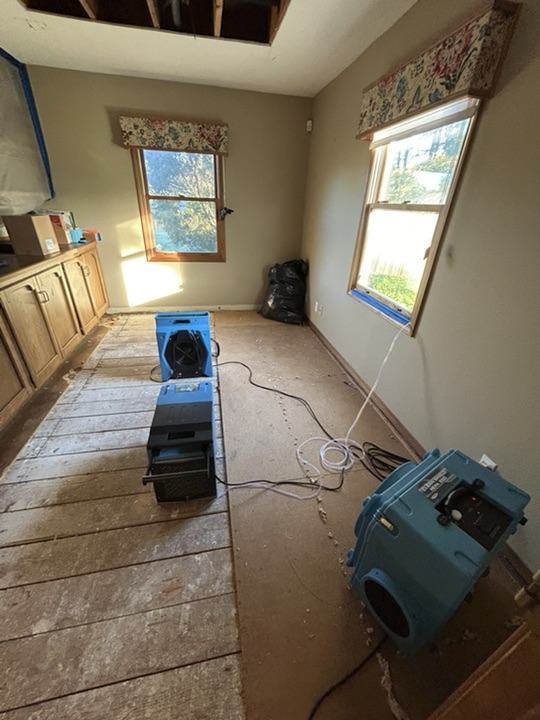
Then there’s the part people forget about until they’re standing in it: the water. Fire crews use a lot of water to put a fire out, and that water goes everywhere, down walls, under flooring, into places gravity takes it. Cleaning that up is its own job and it has to happen fast, because standing water and saturated drywall start growing mold within days, not weeks.
From there it’s rebuilding the rooms that were damaged, framing, drywall, trim, flooring, whatever the fire and water took. And through the whole thing, documentation for the adjuster matters. Photos, moisture readings, an itemized account of what was removed and why. That paperwork is what moves a claim along, and it’s easier to do well while the work is happening than to reconstruct afterward.

About 76% of occupied homes in Braselton are owner-occupied, which means most of the calls we get are from the person who actually owns the house, not a property manager juggling several units. That tends to make decisions move faster since there’s one person, or one couple, making the call instead of a chain of approvals. It also means the owner is usually the one dealing directly with the insurance adjuster, which is where good documentation earns its keep.
The remaining homes that are rented still need the same work done to the same standard. A landlord isn’t going to be on site as often, so clear communication and thorough records matter even more on those jobs.
A fire restoration company handles it, covering board-up and securing the property, removing fire-damaged materials, cleaning up the water used to fight the fire, rebuilding the damaged rooms, and documenting everything for the adjuster. Committed Restoration is IICRC certified and answers calls 24/7, so you’re not waiting until business hours to get someone on the phone.
The property needs to be secured first, usually board-up and tarping over any openings, because an unsecured house invites weather damage and worse. After that, damaged materials get removed, the water from firefighting efforts gets cleaned up before mold sets in, and rebuilding starts once everything is documented for the insurance claim.
It depends on how hot the fire burned and how far the smoke traveled, which varies a lot even within similar-aged Braselton homes, so there’s no blanket answer. Some cabinetry, flooring, and structural framing outside the immediate burn area can sometimes be cleaned and restored rather than replaced, but that’s a judgment call made room by room, not house by house.
Yes, and it matters here because about 3% of Braselton’s housing was built before 1980 while most of the rest is considerably newer. Newer construction tends to use engineered lumber and synthetic finishes that behave differently in heat and produce different soot than older plaster-and-lumber homes, which changes what gets removed versus cleaned.
Yes, professional fire and smoke damage restoration follows the IICRC S700 standard, which sets the order of operations from assessment through cleaning to rebuild. Following that order is what prevents smoke odor or moisture from getting sealed behind new drywall before it’s fully addressed.
Sources: US Census Bureau, American Community Survey 2023 5-year estimates; IICRC, ANSI/IICRC S700 Standard. Read 2026-11-14.