





Gwinnett County has been named in 9 federal disaster declarations for storms, flooding or fire since 2000, and the most recent list reads like local news: Hurricane Isaias in 2026, a severe winter storm the same year, and Hurricane Helene in 2024. That is not a reason to panic every time it rains in Buford, but it is a reason to have a plan before the next one shows up, because by the time the wind is loud enough to worry about, it is too late to go looking for a tarp.

Wind takes shingles and sometimes whole sections of roof decking. Once the roof is open, every hour of rain after that is water finding its way into insulation, drywall, and whatever is stacked in the attic. A tree coming down on a house is worse, because it usually punches a hole and cracks framing at the same time, which means the structure itself needs to be checked before anyone worries about the water.
In the first few hours: get people out from under anything that looks compromised, keep power off to any area that took water, and get a photo of the damage before you move or cover anything, since the adjuster will want to see the house as the storm left it. Committed Restoration answers calls 24/7, and in Buford a crew typically arrives within the hour for emergencies, which matters most for roof tarping and board-up, where every extra hour of open weather means more interior damage.
The EPA’s guidance is specific on this: material that gets dried out within 24 to 48 hours will, in most cases, not grow mold. Past that window, the odds shift fast, especially in a Gwinnett summer where the air itself is already carrying moisture. That is why water removal is not a step you schedule for next week. It is the step that decides whether the drywall and subfloor can be saved or have to come out.
The work follows the IICRC S500 standard, which is the industry reference for how water damage restoration should be measured, documented, and dried, not just mopped up and painted over. For a homeowner, that mostly means the drying is checked with equipment, not guessed at by feel. One thing you can check yourself, today: go look at your attic insulation and any exterior wood trim for soft spots or discoloration. If you find dampness that was not there before the last storm, that is worth a call regardless of whether you see a stain on the ceiling yet.
One more thing worth knowing before you call your insurance company: most homeowners policies do not cover flood damage on their own. Flood coverage is a separate policy, and the distinction between wind-driven rain through a broken window and water that rose from outside the house is often the first question an adjuster asks.
After a storm hits a Buford house, the work usually runs in this order. First, emergency board-up and roof tarping, to stop the bleeding and keep the house secured overnight. Then water removal, pulling out what the storm pushed in before it sits long enough to do more damage. Then cleanup after fallen trees and debris, which in a lot of Buford yards means clearing limbs and trunk sections off a roof or driveway before anyone can get a ladder up safely. Last comes the actual repair to the structure, whether that is replacing decking and shingles or rebuilding framing where a tree went through.

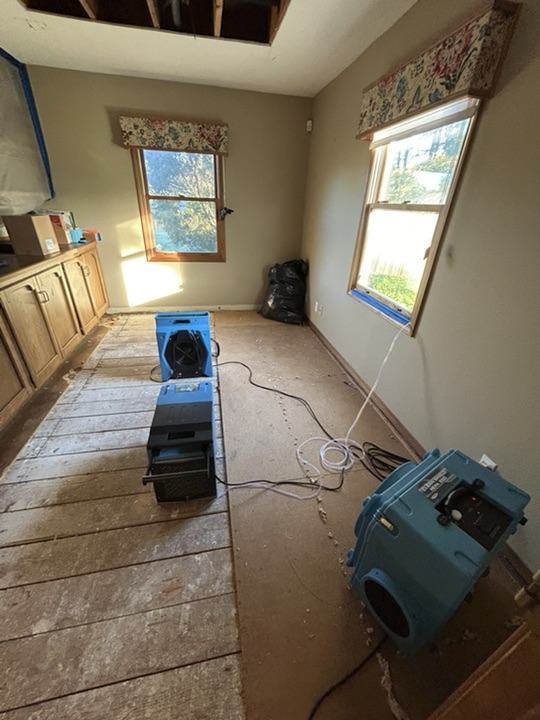
About 70% of occupied homes in Buford are owner-occupied, with the rest rented out. That split matters because an owner can authorize emergency work on the spot, while a renter usually has to get the property owner or manager on the phone first, even if the water is actively coming in. If you rent in Buford and a storm hits, it is worth knowing ahead of time who that call needs to go to, because the drying clock does not wait for paperwork.
Buford’s stormwater management program names Richland Creek and Suwanee Creek among the city’s receiving waters, which is the drainage path a lot of runoff eventually follows whether or not a given property sits near either creek. FEMA’s records show 19 National Flood Insurance Program claims filed across Buford’s ZIP codes, 30518 and 30519, since 2000, with the most in any single year being 6, back in 2013.
That number describes the area, not your specific lot. A low claims count does not mean a house is safe from water intrusion during a hard storm, and a house a half mile from either creek can still take on water through a failed roof or a bad grade around the foundation. If you want to know what a flood map actually says about your parcel, that is a question for the city’s stormwater department or a flood determination, not a general claims count.
Committed Restoration handles emergency roof tarping and board-up in Buford, and the crew typically arrives within the hour for emergencies, answering calls 24/7 so a damaged roof is not left open overnight.
Get everyone clear of the area, check that no one is near cracked framing or a hole in the roof, and call for emergency board-up and tree and debris cleanup before attempting to move branches or cover the opening yourself.
Buford’s stormwater program lists Richland Creek and Suwanee Creek among its receiving waters, and FEMA has recorded 19 flood insurance claims across Buford’s ZIP codes since 2000, but that describes the area generally, not any one property.
Half of Buford’s homes were built in 1994 or earlier, and about 29% were built before 1980, which means a fair number of roofs and structures being repaired after a storm are working with older materials and older framing methods than a new build.
About 70% of occupied homes in Buford are owner-occupied, so most storm calls come from owners who can authorize work directly, while renters typically need to loop in the property owner or manager before repair work can proceed.
Sources: City of Buford, Stormwater Management Program (2023); US Census Bureau, American Community Survey 2023 5-year estimates; FEMA, OpenFEMA NFIP Redacted Claims; FEMA, OpenFEMA Disaster Declarations Summaries; IICRC, ANSI/IICRC S500 Standard; US EPA, A Brief Guide to Mold, Moisture and Your Home; FEMA, FloodSmart (National Flood Insurance Program). Read 2026-11-14.