





FEMA’s records show 1 National Flood Insurance Program claim filed for ZIP code 30548 since 2000. If you’re searching for water damage cleanup in Hoschton because water is sitting on your floor right now, that number isn’t going to help you much tonight. It tells you something about the area over two decades. It tells you nothing about the pipe that just let go under your kitchen sink.

One NFIP claim since 2000 for the whole ZIP code is a low number. It means Hoschton hasn’t had a lot of homes file for flood insurance payouts in that stretch. It does not mean your particular house is safe from water, and it doesn’t say anything about the creek behind a neighborhood or how a yard grades after a hard rain.
A flood zone map is built for insurance purposes. It’s drawn around elevation and known floodplains, not around your specific foundation, your gutters, or the slope of your driveway. A house can sit outside any mapped flood area and still take on water from a burst pipe, a failed water heater, or a roof that gives out in a storm. Flood insurance and homeowners insurance are two different things, and most homeowners insurance does not cover flood damage on its own. That distinction matters more than the claims count does, because it’s the one an adjuster will ask about first.
Water doesn’t wait for you to notice it. Drywall wicks it up the wall by capillary action, and it keeps climbing even after the water on the floor is gone. Subfloor swells. Baseboards cup. In a crawlspace or a finished basement, the framing behind the wall can be holding moisture long after the surface looks dry.
The EPA’s guidance is that materials dried within 24 to 48 hours generally won’t grow mold. After that window, the odds go up fast, especially in Georgia humidity. That’s why the work follows the IICRC S500 standard, which is the accepted method for professional water damage restoration in homes and commercial buildings. In practice that means moisture is measured with meters, not guessed at by touch, and drying is monitored day to day instead of declared finished because the carpet feels dry underfoot.
One thing you can check yourself today: look under sinks, around the water heater, and at any exposed supply lines for a slow drip or a damp spot. A lot of water damage in a flooded basement cleanup starts small and goes unnoticed for weeks before it becomes a visible problem.
Extraction comes first, pulling standing water out after a leak, an overflow, or flooding, whether that’s a burst pipe water damage situation in the kitchen or a basement that took in rainwater. If the water is contaminated, sewage and contaminated-water cleanup follows a different protocol than clean water does, because the risk is different.
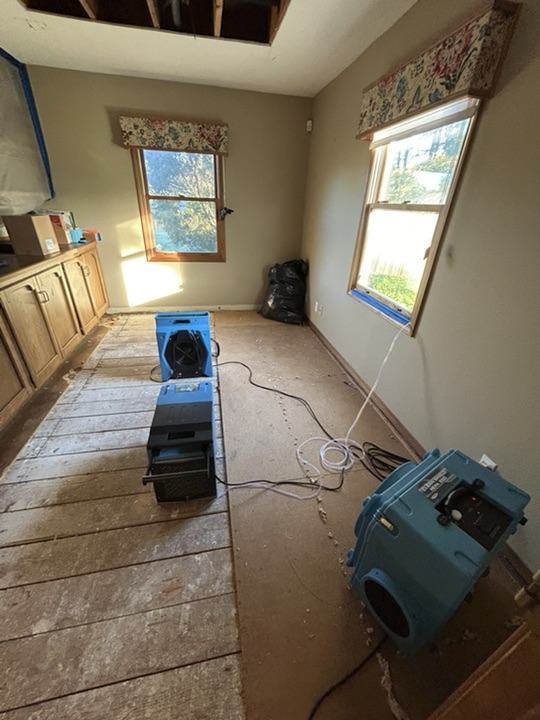
After extraction, moisture mapping shows where water traveled inside walls and under flooring, areas you can’t see just by looking. Drying is then monitored against those readings instead of guessed at. Once things are dry, repair work addresses whatever walls, floors or finishes were affected. Throughout the job, the damage gets documented, which matters for the homeowner’s own records and for the adjuster if a claim is involved.

Half the homes in Hoschton were built in 2006 or earlier, and about 11% of the housing stock goes back before 1980. That’s a mix of newer construction and older homes, and it matters for how a water loss plays out.
Newer homes, from the 2000s building boom, tend to have PEX plumbing and engineered flooring. PEX handles freeze and pressure better than old copper, but engineered floors and particleboard subfloor swell and delaminate fast once they get wet, sometimes faster than solid wood would. The smaller share of older homes, from before 1980, are more likely to have original plumbing that’s simply aging out, along with plaster or older drywall that behaves differently once it’s saturated. Either way, what fails and how fast depends on what’s actually behind the wall, which is part of why a moisture map matters more than a guess.
Jackson County has been named in 10 federal disaster declarations for storms, flooding or fire since 2000, including Hurricane Isaias, a severe winter storm, and Hurricane Helene. That’s a county-level count, so it covers more than just Hoschton, but it says the area isn’t a stranger to weather events serious enough to draw federal attention.
In the hours after a storm like that, check the obvious spots first: basement, crawlspace access, around windows and the roofline inside the attic if you can get to it safely. Standing water that’s been there for more than a day behaves differently than water you catch right away, so the sooner it’s addressed the fewer materials usually need to come out.
Committed Restoration answers calls 24/7, so you can reach someone tonight at (678) 837-6999 for water extraction, sewage cleanup, or storm damage.
The EPA says materials dried within 24 to 48 hours generally won’t grow mold, which is why monitored drying rather than a quick once-over is part of doing the job right.
Not necessarily. FEMA’s claims data for ZIP code 30548 shows only 1 NFIP claim since 2000 for the whole area, but that figure describes the ZIP code, not any single property, and a flood map doesn’t account for your specific lot or plumbing.
Most homeowners insurance does not cover flood damage specifically, since flood coverage is a separate policy, so it’s worth knowing which category your situation falls into before you file a claim.
The work follows the IICRC S500 standard, the accepted industry standard for professional water damage restoration in homes and commercial buildings, which covers how moisture is measured and documented, not just how water is removed.
Sources: US Census Bureau, American Community Survey 2023 5-year estimates; FEMA, OpenFEMA NFIP Redacted Claims; FEMA, OpenFEMA Disaster Declarations Summaries; IICRC, ANSI/IICRC S500 Standard; US EPA, A Brief Guide to Mold, Moisture and Your Home; FEMA, FloodSmart (National Flood Insurance Program). Read 2026-11-14.