





Half of the homes in Hoschton were built in 2006 or earlier, which the Census Bureau figures from sampling, not a walk down every street in town. Still, that number tells you something useful: a lot of Hoschton houses are in their second decade now, old enough for a water heater to be on its original tank and for supply lines to be showing their age, but not so old that the whole house is suspect. When a line lets go or a heater splits, what happens next depends a lot on what’s actually behind that drywall.

Most of Hoschton’s housing stock sits in that newer-but-not-new range, built with the materials and codes common in the early 2000s. That means PEX or copper supply lines in a lot of homes, standard water heaters with the usual ten-to-fifteen-year service life people forget about, and drywall and subfloor that behave exactly like drywall and subfloor anywhere else once water gets into them.
About 11% of Hoschton’s housing was built before 1980, which is a smaller slice than you’d see in some older towns nearby. Those older homes are the ones more likely to have had plumbing replaced at some point, or not, and galvanized pipe or older fittings tend to be the weak point when they haven’t. Either way, the age of the house tells you where to look first. It doesn’t tell you whether today is the day something fails.
Drywall wicks water upward from the bottom, the way a paper towel pulls up a spill. Cut it a few inches above the visible water line and you’re usually above where the water actually traveled, because wet drywall sags and discolors well before the top edge looks wrong. That’s the short version of why we cut low instead of guessing by eye.
The work follows the IICRC S500, which is the industry standard for water damage restoration in homes and commercial buildings. For a homeowner, what that means in practice is that drying isn’t finished when things look dry. We take moisture readings in the material itself, not the air, and keep monitoring until the numbers say the structure is actually back to normal, not just visually dry. The EPA notes that water-damaged areas and items dried within 24 to 48 hours will, in most cases, not grow mold, which is the reason speed matters more than almost anything else in this job.
One thing you can check yourself today: find your water heater’s age on the data plate, and know where your main shutoff valve is. If you’ve never had to turn it off, that’s worth fixing before you need to.
About 76% of occupied homes in Hoschton are owner-occupied, with the rest rented out. For an owner, the decision to call for extraction and drying is usually a one-person call, and that person is also the one dealing with the insurance adjuster directly. For a rental, there’s often a landlord or property manager who needs to be looped in before work starts, and sometimes a tenant standing in the middle of it who isn’t sure who to call first. Either way, the standing water doesn’t wait on that conversation, so the extraction and the paperwork can happen on two different tracks.

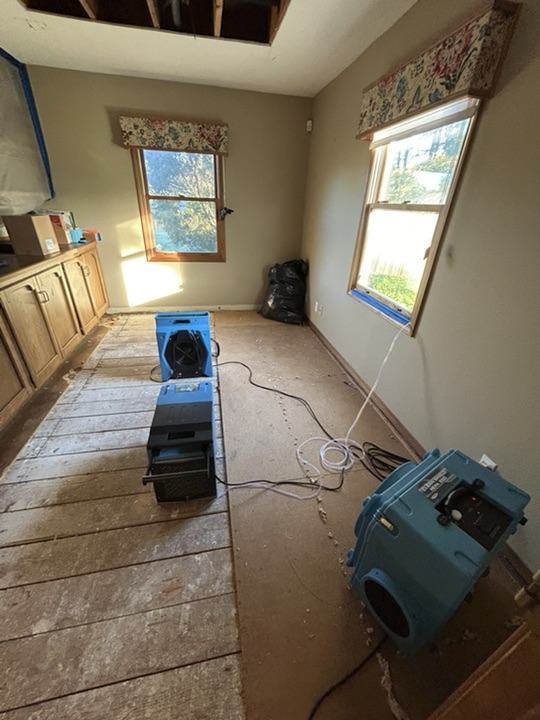
Shut off the water source if you can find it and it’s safe to reach. Move anything you can lift off the wet floor, especially furniture with wood legs and anything electronic. Don’t run a shop vac on standing water if there’s any chance it’s near an outlet. If you’re not sure what’s safe to touch, wait for us. We answer calls 24/7, so there’s no need to sit on a growing problem until business hours.
Committed Restoration answers calls 24/7, so emergency water removal and extraction isn’t limited to business hours, whether it’s a burst line at 2 a.m. or a water heater that finally gave out.
Mitigation is the stop-the-bleeding phase: extracting standing water, removing materials that can’t be saved, and drying the structure to stop further damage. Restoration is the rebuild that happens after, once the structure is confirmed dry.
Drywall pulls water upward from the bottom edge, so the damage usually extends higher than it looks. Cutting a section near the floor lets us remove the wet material and check what’s happening inside the wall cavity, rather than guessing from the surface.
We take moisture readings in the materials themselves, not just the air, and keep monitoring until those readings come back to normal. The work follows the IICRC S500 standard, which sets out how that drying and verification should be done.
It can. About 11% of Hoschton’s homes were built before 1980, and older plumbing in those houses is more likely to be a weak point. But house age describes a general pattern across town, not a guarantee about what’s behind your specific walls.
Sources: US Census Bureau, American Community Survey 2023 5-year estimates; IICRC, ANSI/IICRC S500 Standard; US EPA, A Brief Guide to Mold, Moisture and Your Home. Read 2026-11-14.