





Lawrenceville runs its own stormwater utility and publishes GIS maps so residents can look up drainage on their own street, which tells you the city already knows water doesn’t always stay where it’s supposed to. That map won’t tell you whether your particular crawlspace floods, but it’s a reasonable place to start before you call anyone. When it does flood, or a pipe lets go, or a pan fire gets out of hand, the work that follows is the same no matter what triggered it: get the water or smoke out, dry or clean what’s salvageable, and put the structure back together.
FEMA’s claims data shows 151 National Flood Insurance Program claims filed across Lawrenceville’s ZIP codes since 2000, with the worst year being 2009 at 97 claims. That’s a count across four ZIP codes, not a prediction for any one house. It tells you flooding has happened here repeatedly, not that your address is or isn’t at risk.
Gwinnett County has been named in 9 federal disaster declarations for storms, flooding or fire since 2000, most recently Hurricane Isaias and a severe winter storm in 2026, and Hurricane Helene in 2024. That’s a lot of named weather events touching the same ground over two decades, and each one tends to bring a wave of calls behind it: trees through roofs, water pushed in under doors, power out long enough for sump pumps to quit.
Housing age matters too. Half of Lawrenceville’s homes were built in 1987 or earlier, and about 31% of the housing stock predates 1980. Older plumbing, older roofing, older slab and crawlspace work. None of that causes a leak by itself, but it means less margin when something does go wrong, and it means the materials behind the wall are often not what’s sold at the counter today.
With half of Lawrenceville’s homes dating to 1987 or earlier, and close to a third built before 1980, a good chunk of what we open up has plaster, older wiring runs, or plumbing that was never meant to be modern. That changes how a wall gets opened and what gets found inside it. It doesn’t change the drying standard, but it does change how carefully you have to work to get there.
About 49% of occupied homes in Lawrenceville are owner-occupied, the rest rented. Permits for rebuilding, whether after water, fire or storm damage, go through the City of Lawrenceville, and that process doesn’t care whether the resident owns or rents. What changes with occupancy status is usually who’s coordinating the work and who’s filing the claim, not what inspectors require.
Whether it’s a slab leak in a home built before 1980 or stormwater pushing in through an older foundation, the first job is getting water out before it travels further into flooring and drywall. That includes sewage and contaminated-water cleanup when a backup is involved, moisture mapping so drying equipment goes where it’s actually needed, and repair of whatever walls, floors or finishes didn’t survive. We document the damage as we go, which is the record an adjuster will usually ask for.
Water damage restoration in Lawrenceville
Mitigation is the work that happens before repairs even start: pulling standing water, removing carpet pad or drywall that’s too wet to save, and setting drying equipment that gets monitored until moisture readings come back where they should be. In a city where a fair share of housing was built decades ago, that monitoring step matters, because older materials don’t always dry the way newer ones do. Answering calls 24/7 means that work can start the same night a pipe fails instead of after a weekend wait.
After a fire, the property gets boarded up and tarped first to keep weather and trespassers out, then fire-damaged materials come out. There’s almost always water damage too, from whatever put the fire out, and that gets cleaned up the same way any other water intrusion would. From there it’s rebuilding the affected rooms, with documentation kept the whole way through for the adjuster.
Fire damage restoration in Lawrenceville
Smoke travels further than the fire itself, often riding the HVAC system into rooms that never saw flame. That means soot on walls and ceilings well away from the source, and an odor that doesn’t fade on its own. Cleanup covers the soot, the smoke-affected ductwork and HVAC areas, and the odor itself, with smoke-damaged materials cleaned where possible and replaced where they can’t be.
Mold shows up after water sits too long, which happens more easily in older crawlspaces and basements common across Lawrenceville’s pre-1987 housing stock. The inspection starts by finding the moisture source, because removing mold without fixing what fed it just buys time. From there it’s containment, removal of the affected materials, and drying the area thoroughly enough that it doesn’t come back.
When a room needs to be gutted or dried out for days, belongings need to be somewhere else. We pack and remove contents, clean what can be saved, and store it securely with an inventory of what went where. When the structural work is done, move-back is organized rather than just dropped at the curb.
Gwinnett County’s run of federal disaster declarations, including recent hurricanes and a winter storm, means fallen trees, roof damage and water intrusion aren’t rare events here. That starts with emergency board-up and roof tarping, then water removal if the storm got inside, debris cleanup from downed trees, and repairs to whatever the structure lost.
Storm damage cleanup and repair in Lawrenceville
Structural repairs after water, fire or storm damage come last, once everything wet or burned is out and the space has dried or been cleared. That covers drywall, flooring and interior finishes, handled by the same team that did the cleanup, so nothing gets lost between one contractor finishing and another starting.
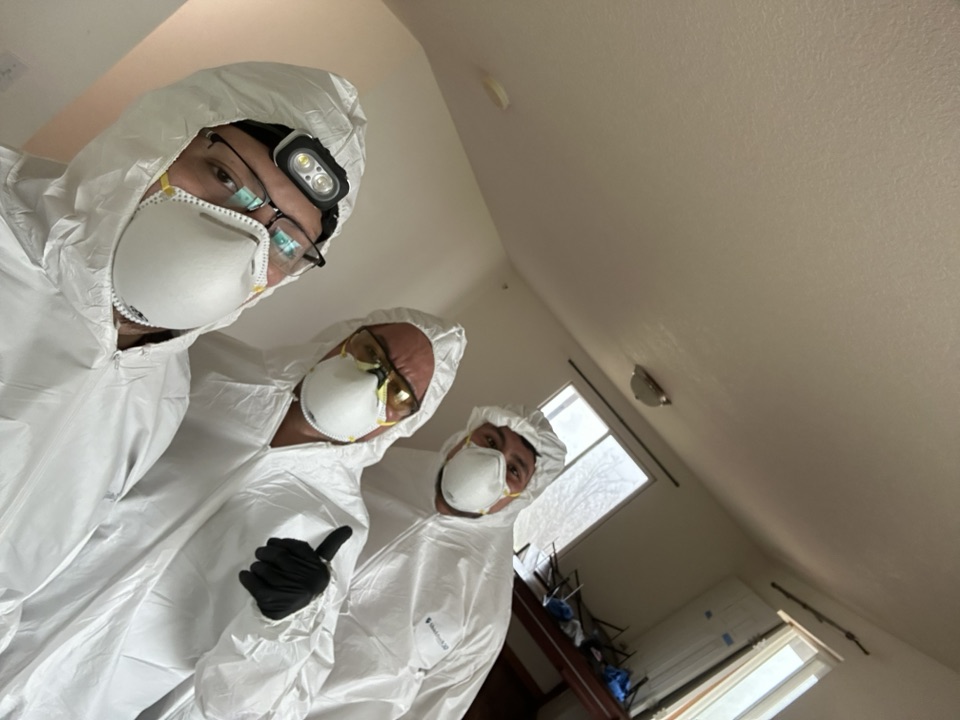
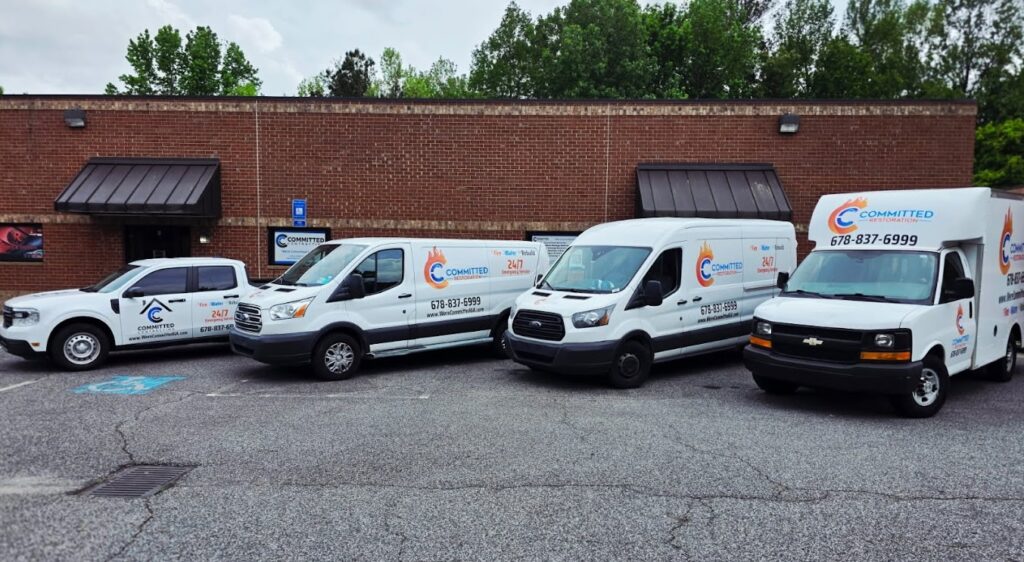
In an emergency, a Committed Restoration crew typically arrives within the hour. That’s the standard we work to for Lawrenceville calls, and it’s the reason the first phone call matters more than people think: the clock on water damage starts the moment the water does, not when someone shows up to look at it.
We answer calls 24/7, which matters most at 2 a.m. when a supply line fails or a basement starts taking on water during a storm and nobody wants to wait until business hours to find out if it’s bad. Our techs are IICRC certified, which means the drying, cleaning and rebuilding follows documented industry procedure rather than guesswork, and that documentation is often what an adjuster wants to see anyway.

Assess the source and the rooms and belongings affected.
Discuss urgent work, access, and the proposed restoration estimate.
Coordinate cleanup and drying with contents handling.
Complete reconstruction where needed and review the finished work together.
We explain the proposed work and document the damage for your records. We can also help communicate findings to your adjuster. Your insurer determines coverage and payment.
Yes. Committed Restoration answers calls 24/7, and for Lawrenceville emergencies a crew typically arrives within the hour.
Committed Restoration covers all of it: water damage restoration and mitigation, fire and smoke damage restoration and cleanup, mold removal and remediation, plus contents pack-out, storm damage cleanup and the reconstruction that follows any of these.
We document the damage as part of our water and fire restoration work, which is the kind of record an adjuster typically asks for. We don’t speak to what your specific policy will or won’t pay.
FEMA’s records show 151 NFIP claims filed for Lawrenceville’s four ZIP codes since 2000, with the heaviest year, 2009, accounting for 97 of them. That figure covers the area as a whole, not any single address.
Half of Lawrenceville’s homes were built in 1987 or earlier and about 31% predate 1980, which generally means older plumbing and roofing with less built-in margin for error, but age alone doesn’t tell you whether a specific house has a problem. An inspection does that.
Sources: City of Lawrenceville, Stormwater Utility; US Census Bureau, American Community Survey 2023 5-year estimates; FEMA, OpenFEMA NFIP Redacted Claims; FEMA, OpenFEMA Disaster Declarations Summaries. Read 2026-11-14.