





Lawrenceville sits in Gwinnett County, which has been named in 9 federal disaster declarations for storms, flooding or fire since 2000, with Hurricane Isaias and a severe winter storm both landing in 2026 and Hurricane Helene in 2024. That is not a reason to panic every time the sky turns green, but it is a reason to have a plan before the next one shows up, because storms here are not a once-a-generation thing. They are closer to a standing appointment.

The declarations on record cover hurricanes that weaken into wind and rain events by the time they reach Gwinnett, and winter storms that snap limbs under ice load. Both put trees into roofs. Both push water past flashing that was fine the week before.
If a tree has come through the roof or a wall, the first job is stopping the weather from finishing what the storm started. That means board-up on broken windows and doors, and a tarp over any opening in the roof deck. Until that happens, every hour of rain is getting into insulation, drywall and framing that were dry an hour ago.
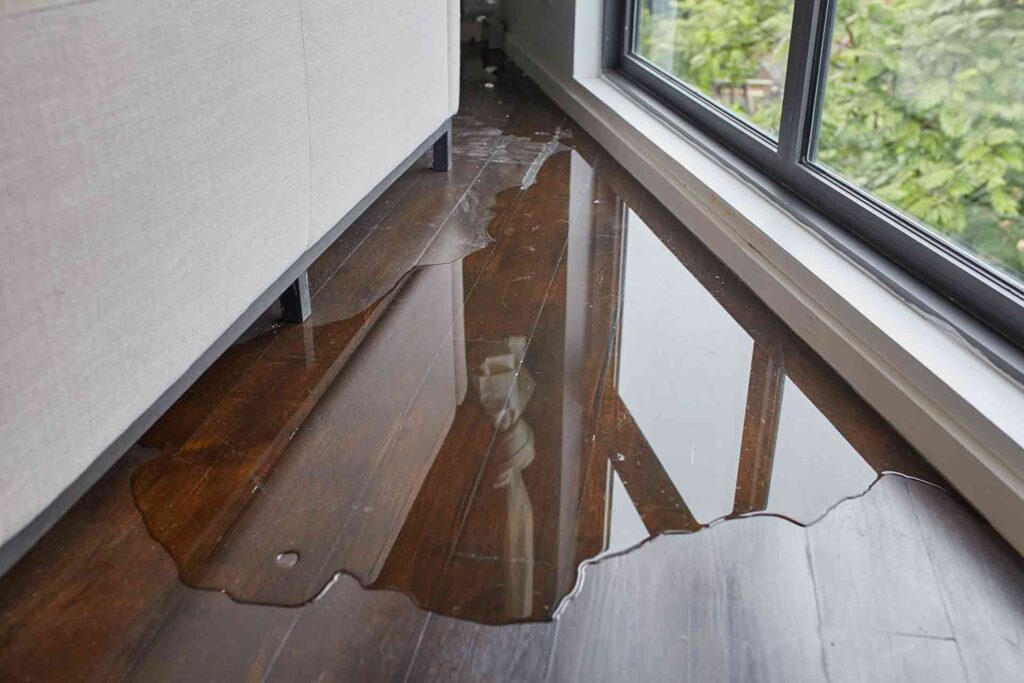
After the opening is covered, the next question is whether water got into the living space. If it did, pulling it out fast matters more than almost anything else in the job.
About 49% of occupied homes in Lawrenceville are owner-occupied, which means the other half are rental households where the tenant is not the one who decides on repairs. If you rent, the property owner or management company is usually the one who needs to authorize board-up and repair work, even if you are the one standing in the house looking at a hole in the ceiling. Knowing who that contact is before a storm hits saves time when it counts.
Half of Lawrenceville’s homes were built in 1987 or earlier, and about 31% go back before 1980. Older framing and older drywall were not built to get wet and dry out on their own schedule. Wood swells, tape joints separate, and insulation that stays wet loses its ability to insulate at all.
The EPA’s guidance is specific on timing: materials dried within 24 to 48 hours will, in most cases, not grow mold. Past that window, the odds move against you fast, especially in a house with older wall cavities that trap moisture longer than newer construction does.
Professional water damage restoration work follows the IICRC S500 standard, which sets out how drying should be measured and documented, not just eyeballed. That matters to a homeowner because it means the job is tracked with moisture readings until the materials are actually dry, not just until they look dry.
One thing you can check yourself today: find your home’s age on your county tax record or appraisal notice. If it was built before the 1980s, your walls likely have less vapor barrier than a newer build, and that is worth mentioning to whoever is doing the drying.
On insurance, the distinction that matters is the one between storm water that came in through a broken roof or window, and flood water that rose up from outside. Most homeowners insurance does not cover flood damage. Flood coverage is a separate policy, and an adjuster will often ask how the water got in before anything else.


Lawrenceville runs its own stormwater utility and publishes GIS maps residents can use to look up local drainage, which is a useful first stop if you want to know whether your street sits near a mapped drainage path. FEMA’s records show 151 National Flood Insurance Program claims filed for Lawrenceville’s ZIP codes since 2000, with the heaviest year being 2009 at 97 claims.
That number describes the area across four ZIP codes, not any single house, and a lot can change between a 2009 claim and a home built or renovated since. A map or a claims history can tell you that water has moved through a neighborhood before. It cannot tell you whether your particular foundation, grading or gutters will hold up the next time it rains hard. For that you need an actual look at the property, not just a lookup.
A tree on the house, an open roof, broken windows facing the weather, or standing water inside are call-now problems. Every hour changes the damage. Committed Restoration answers calls 24/7, which matters because storms do not keep business hours either.
A few shingles gone or minor gutter damage with no active water intrusion can usually wait for daylight, as long as nothing is open to the weather. The test is simple: can rain or wind still get in right now? If yes, that is tonight’s problem, not tomorrow’s.
Committed Restoration does emergency board-up and roof tarping, and answers calls 24/7, so a tarp can go on an open roof before more rain gets into the structure.
Get the opening covered first. Emergency board-up and roof tarping stops ongoing water intrusion, and cleanup of the fallen tree and debris, along with any structural repairs, follows once the house is no longer open to the weather.
Most homeowners insurance does not cover flood damage, since flood coverage is a separate policy, which is why adjusters often ask whether water came from a roof or window versus rising water outside.
Lawrenceville’s stormwater utility publishes GIS maps residents can check for drainage information near their address, though a map describes the area and does not guarantee anything about one specific house.
Half of Lawrenceville’s homes were built in 1987 or earlier and about 31% predate 1980, and older framing and insulation tend to hold moisture longer, so drying work on these homes needs closer attention to the standard drying window.
Sources: City of Lawrenceville, Stormwater Utility; US Census Bureau, American Community Survey 2023 5-year estimates; FEMA, OpenFEMA NFIP Redacted Claims; FEMA, OpenFEMA Disaster Declarations Summaries; IICRC, ANSI/IICRC S500 Standard; US EPA, A Brief Guide to Mold, Moisture and Your Home; FEMA, FloodSmart (National Flood Insurance Program). Read 2026-11-14.